On a grey Tuesday morning in mid-March, the stretch of Granville Street between Nelson and Helmcken was unremarkable in the way that most downtown Vancouver mornings are: commuters with coffee, delivery trucks idling, pigeons ignoring everyone. Then, without warning, it started to rain money.
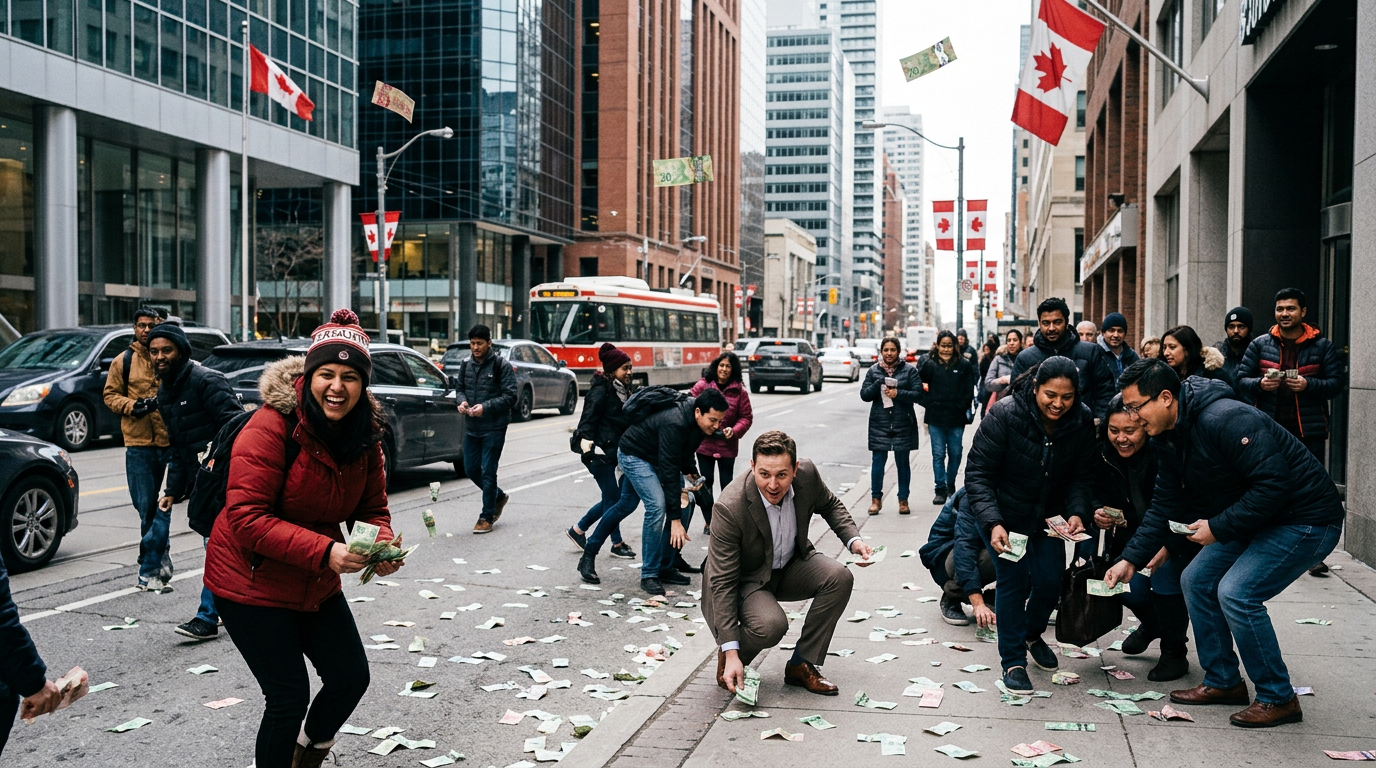
Bills — mostly twenties and fifties, some hundreds — floated down from the eighth floor of a heritage building that overlooks one of the city's busiest pedestrian thoroughfares. Within seconds, strangers were laughing, crouching, reaching out with both hands. Within minutes, a crowd of several hundred had gathered. Within the hour, footage filmed from at least a dozen different phone cameras had spread across social media platforms and into the feeds of people who had never heard of Eleanor Park — and who, by the end of the day, very much had.
The Woman Behind the Moment
Eleanor Park, 67, arrived in Vancouver from Busan, South Korea, with her parents in 1981 as a teenager. The family settled in Strathcona, and Eleanor watched her mother — a seamstress who worked six days a week and still found time to feed the neighbours — practice a version of generosity that felt as natural as breathing. It was a lesson that stuck.
In 1995, after working for a decade in community outreach services, Eleanor founded the Granville Street Community Kitchen — a volunteer-run soup kitchen and food distribution centre that grew, over three decades, from a church basement operation serving forty lunches a day to a full-scale facility providing nearly 600 meals daily, a weekly grocery hamper programme, and a drop-in counselling service for recently arrived newcomers. She never sought media attention. She gave almost no interviews. She raised millions of dollars through the sheer force of her personal relationships and her reputation for showing up, year after year, without complaint or credit.
"Ellie never thought of herself as doing something special. She thought the kitchen was just what you did if you had a kitchen and people were hungry. The rest of us spent thirty years trying to live up to that logic."
— James Okafor, volunteer coordinator, Granville Street Community Kitchen
The Plan That Took Six Months
When Eleanor announced in September 2025 that she would retire at the end of March, her core team of volunteers — some of whom had worked alongside her for more than fifteen years — quietly began planning a tribute. They ruled out a dinner early on. Eleanor hated dinners in her honour. They considered a neighbourhood parade, but it felt too formal. Someone suggested the rooftop idea as a joke, and then, gradually, it stopped being a joke.
The group spent six months raising $18,000 through private donations from former volunteers, local businesses, and community members who had heard through informal channels that something was being planned. They secured permission from the building owner, a longtime supporter of the kitchen. They coordinated with the City of Vancouver for a brief closure of the pedestrian zone below. They printed paper inserts for each bundle of bills directing anyone who caught money to a website where they could donate it back to the kitchen — or keep it, if they needed it. That last detail, volunteers said, was the one Eleanor herself would have insisted on.
What Happened on Granville Street
At 10:47 on a Tuesday morning, twelve volunteers in yellow jackets leaned over the railing of the eighth-floor terrace and released the bills into the air simultaneously. The wind off English Bay caught them immediately, spreading the money in a wide arc over the street and the small plaza below. The reaction was instant.
Commuters stopped mid-stride. A bus paused at the intersection as its driver and passengers pressed against the windows. A woman with a stroller caught a fifty-dollar bill against her chest and stood still for a moment, visibly unsure whether what was happening was real. Two teenagers in school uniforms abandoned their skateboards entirely. A man in a suit crouched beside a postal worker to pick up bills from the same crack in the pavement, and both of them started laughing at the same time.
Eleanor herself was not present. She was, at that moment, in the kitchen's prep room two blocks away, unaware of what was happening. A volunteer had arranged to drive her past the scene on a pretext. When the car turned onto Granville Street and she saw the crowd, the money still drifting, the people looking upward, she asked what was going on. When she was told, she sat quietly for a long moment before saying, apparently very calmly: "They could have just donated directly."
The City's Response
The footage spread with the particular velocity of moments that are both joyful and unexpected. Several clips accumulated hundreds of thousands of views within the first twenty-four hours. The comments were notably warm, with strangers sharing memories of their own encounters with the kitchen or with Eleanor herself. A number of people who had never visited Vancouver wrote that the clip had made them want to.
The City of Vancouver issued a brief statement acknowledging the event and noting that the necessary permits had been obtained. The Vancouver Police Department confirmed that no charges were laid and that the brief disruption to traffic had been managed without incident. Several city councillors posted the video to their own social media accounts with comments about the role of community organisations in the city's social fabric.
The donation website linked on the bill inserts received more than 4,200 individual contributions in the 48 hours following the event, raising an additional $93,000 for the kitchen — nearly five times the amount that had been scattered on the street. It was, by any measure, the most successful fundraising day in the organisation's thirty-year history.
What the Money Meant to the People Who Caught It
Several people who were present on Granville Street that morning spoke to local media in the days that followed. A university student who caught $80 donated the full amount to the kitchen after reading the insert. A delivery driver who had been passing through on his route kept his $40 — he had not eaten since the previous evening, he said, and used it for groceries. A woman who caught a single twenty-dollar bill said she had been a client of the community kitchen herself, years earlier, and stood on the pavement and cried.
That range of responses — the donation, the groceries, the tears — was, according to those who organised the tribute, exactly what Eleanor had always hoped generosity would produce: not a single predetermined outcome, but a series of small, specific dignities, different for each person, none of them requiring explanation or gratitude.
A Legacy Built Without Looking for Credit
Eleanor Park officially retired on March 28, 2026. The kitchen passed to a new director, a former volunteer who trained under Eleanor for seven years. In her final week, Eleanor reportedly spent most of her time training her replacement, updating procedures, and personally calling every major donor to say thank you. She did not give a farewell speech. She did not pose for photographs. She locked up on her last evening, handed over the keys, and walked home along the same route she had been walking for thirty years.
The video of Granville Street — the money in the air, the strangers laughing, the bus stopped at the intersection — continues to circulate. It has been shared by community organisations across Canada, by Canadian embassies abroad, and by several international news outlets as an example of what one person's sustained commitment to a place can eventually produce. Eleanor has not watched it. Her daughter, who showed it to her once, said she looked at it for about fifteen seconds, shook her head in that particular way, and asked if there was any tea.
Editorial Note: Names and identifying details in this feature story have been changed or composited to protect the privacy of individuals described. This article is a human-interest narrative inspired by documented community events across Canada.