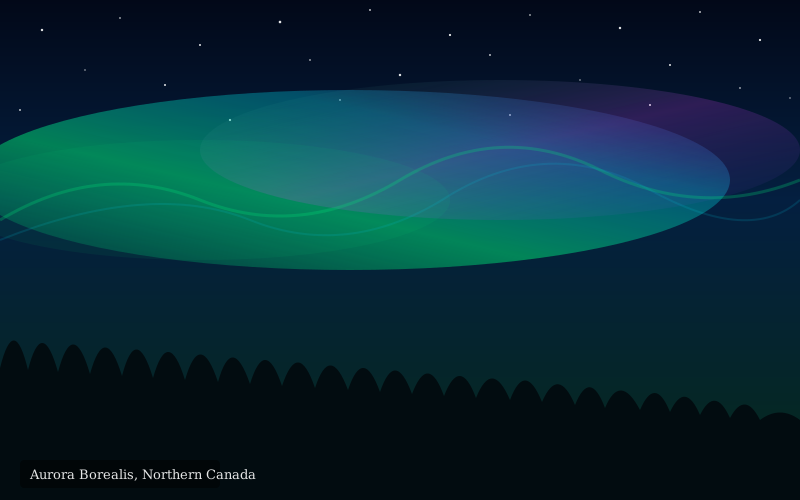
On a clear February night in Whitehorse, Yukon, the temperature has fallen to minus 25 degrees Celsius. The sky is a deep, absolute black, unpolluted by light for hundreds of kilometres in every direction. And then, just above the horizon to the north, a pale green shimmer begins. Within minutes it brightens, shifts and transforms into a curtain of rippling light that moves across the sky with an eerie, silent grace, changing from green to violet to crimson and back to green. The aurora borealis — the northern lights — is one of the most breathtaking phenomena in the natural world, and Canada is one of the best places on Earth to witness it.
The physics of the aurora begins 150 million kilometres away, at the surface of the sun. Solar wind — a continuous stream of charged particles, primarily electrons and protons — flows outward from the sun at speeds of several hundred kilometres per second. When these particles reach Earth, they are deflected by the planet's magnetic field. But at the poles, where the magnetic field lines converge and dip toward the surface, some of these particles funnel down into the upper atmosphere.
The Science of Light
When the solar wind particles collide with gas molecules in Earth's upper atmosphere — primarily oxygen and nitrogen, at altitudes between 100 and 300 kilometres — they transfer energy to those molecules. The molecules release this energy as light. The specific colours produced depend on which gas is being excited and at what altitude: oxygen at high altitudes produces red aurora; oxygen at lower altitudes produces the most common green; nitrogen produces blue and purple hues. The result can range from a faint greenish glow on the northern horizon to an all-sky display of multiple colours.
The intensity of the aurora is closely related to solar activity. The sun goes through approximately 11-year cycles of activity, and at the peak of a solar cycle — called solar maximum — auroral displays are more frequent and more dramatic. Solar maximum in the current cycle occurs around 2025–2026, meaning that conditions for aurora viewing from Canada are unusually favourable right now. Exceptionally large solar flares can trigger geomagnetic storms that push the aurora far south of its usual location, sometimes making it visible from southern Canada and even parts of the northern United States.
"There is no adequate preparation for the first time you see a full aurora display. No photograph captures the movement, the scale or the feeling of standing under a sky that seems to be alive."
Where to See the Northern Lights in Canada
Canada is ideally positioned for aurora viewing. The auroral oval — the ring-shaped zone centred on the magnetic pole within which aurora is most frequent — passes directly over the country's northern territories. Cities and towns in the Yukon, Northwest Territories and Nunavut are among the best places on Earth for consistent aurora viewing.
Whitehorse, Yukon, has established itself as one of the world's premier aurora tourism destinations. Its accessible location — served by regular flights from Vancouver — combined with its position under the auroral oval, its low levels of light pollution and its relatively low precipitation make it ideal. Yellowknife, Northwest Territories, is another leading destination, famous for its Aurora Village facility where visitors can watch displays in heated teepees.
Aurora Tourism: A Growing Industry
Aurora tourism has become a significant economic driver for several northern Canadian communities. Visitors from Japan, China, South Korea and across Europe travel specifically to northern Canada to experience the northern lights, often guided by aurora forecast services that use real-time solar wind data and magnetometer readings to predict when displays are likely to occur. The combination of aurora viewing with other northern experiences — dog sledding, snowshoeing, Indigenous cultural programmes and ice fishing — has created tourism products that attract premium spending from international visitors.
For Canadians who cannot easily reach the Yukon or Northwest Territories, there are more accessible options. Northern Manitoba — particularly the area around Churchill — offers good aurora viewing combined with the extraordinary spectacle of the polar bear migration. Even from cities like Ottawa or Montreal, strong auroral events can sometimes be seen on clear, dark nights far from city lights.
Aurora in Indigenous Traditions
Indigenous peoples of the north have observed and interpreted the aurora for thousands of years. In many traditional knowledge systems, the northern lights carry spiritual or communicative significance. For the Inuit, the lights — called aqsarniit in Inuktitut, meaning "the ball players" — were sometimes understood as the spirits of the dead playing games. For the Cree, the lights were the dance of spirits. These interpretations, shaped by thousands of years of intimate observation, add a cultural depth to the phenomenon that purely scientific accounts cannot fully capture.
To stand in the Canadian north and watch the aurora is to experience the same sky — and something of the same wonder — that has moved human beings in this landscape since the first people arrived here, long before written history began. The aurora borealis is, in this sense, both a phenomenon of modern astrophysics and an ancient human inheritance — and Canada, more than almost any other country, offers the chance to experience both dimensions at once.